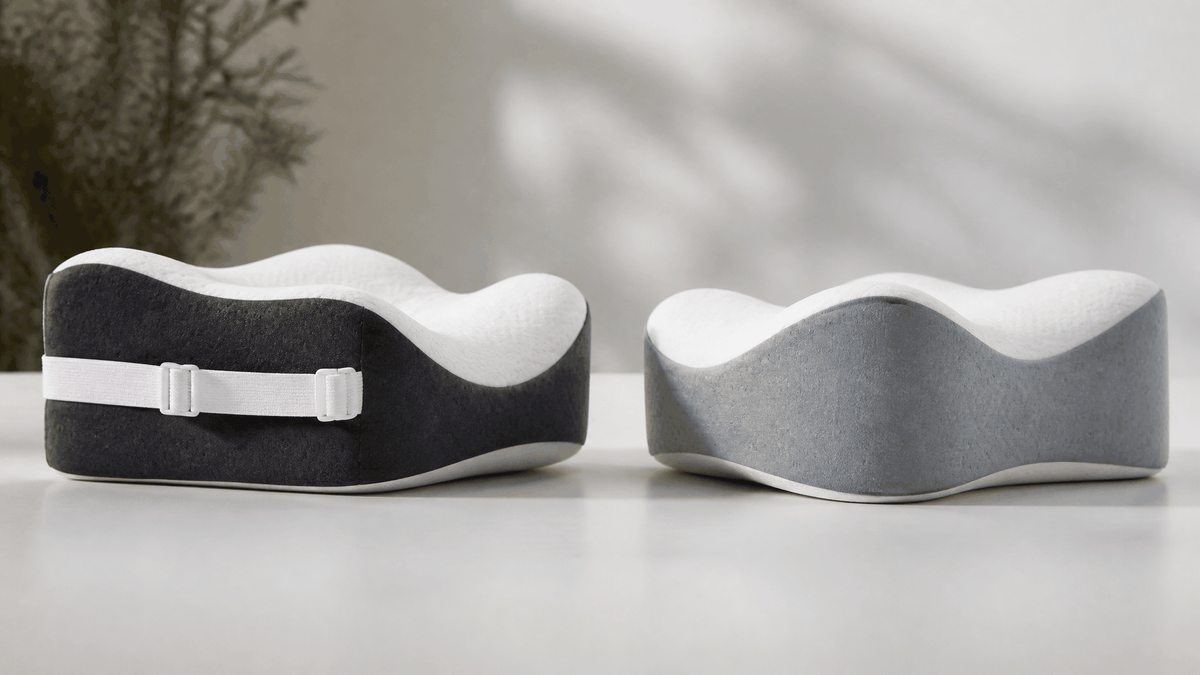
You're not alone if you start on your side and wake up wondering whether your hips got any sleep at all. A Good Housekeeping survey found that over 75% of 10,000-plus respondents sleep on their side. While that position can feel natural, it often pulls the top hip slightly forward, nudging the spine out of neutral and crowding the joints.
A memory foam knee pillow won't remake your mattress, but it can fill the gap between your thighs to help keep your pelvis stacked. The idea has caught the attention of clinical experts, independent test labs, and enough side sleepers that a small pillow now occupies a permanent spot on many nightstands — right next to the phone charger.
Why Memory Foam Knee Pillows Matter for Side Sleepers
Side sleeping lets the top knee drift downward unless something stops it. That drop, as Hospital for Special Surgery physiatrist Jonathan S. Kirschner, MD, RMSK explains, can rotate the hip and pull the lower back out of alignment. The result isn't always dramatic — more like a slow, overnight torque that some people feel as morning stiffness and others never notice.
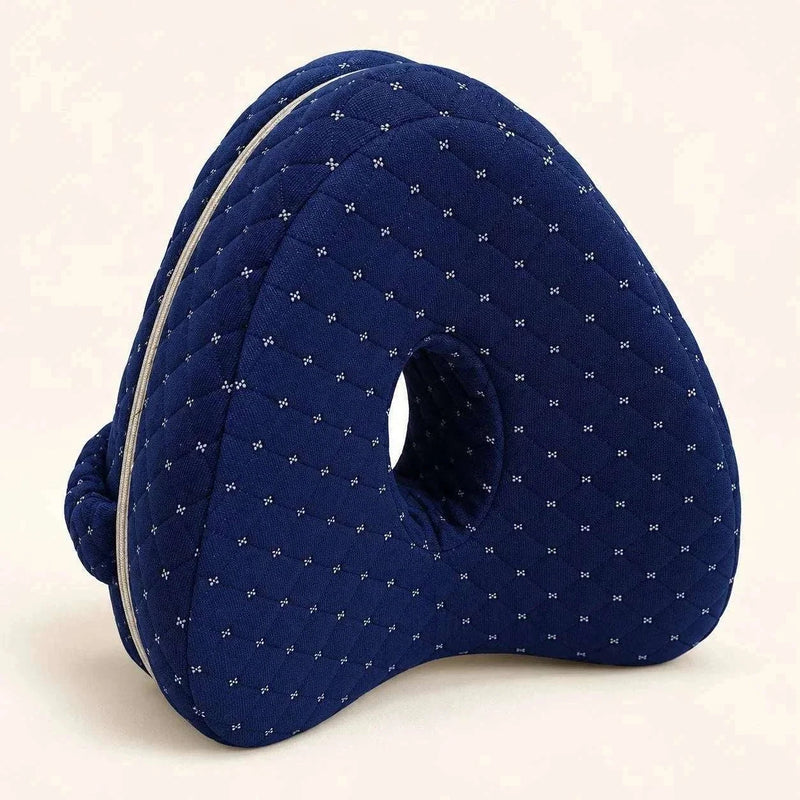
A contoured memory foam pillow placed between the knees may help the hips stay parallel, which Dr. Kirschner describes as a way to reduce pressure across the hip joint. Unlike a standard bed pillow, which tends to flatten and shift, high-density memory foam conforms around the leg without losing its shape, keeping the space that alignment depends on.
What to Look for in a Memory Foam Knee Pillow
Shape is where most decisions start. Contoured hourglass designs, which dip in the middle and widen at the ends, follow the natural curve of the thighs better than simple rectangular blocks. Healthline's knee pillow roundup notes that this shape helps keep the pillow from sliding upward or outward during the night.
Firmness matters because a pillow that collapses under leg weight does little to separate the knees. High-density memory foam — often about 4 to 5 pounds per cubic foot — resists that collapse better than low-density alternatives. Some pillows, including the Coop Home Goods adjustable model, let you remove or add fill to dial in your own level of support.
The extras can tip a purchase: a strap that wraps around the thigh prevents the pillow from wandering when you shift positions, a removable cover that's machine-washable saves time, and a trial period longer than the typical 30 days gives you a week or two to actually feel the difference. The Sleep Foundation advises checking return policies, since a knee pillow that feels fine for 10 minutes may reveal its quirks only after a full night. Standard head pillows, meanwhile, generally lack the density and contour to do the job — they're built for your head, not your legs.
Best Memory Foam Knee Pillows for Side Sleepers
We looked at picks that turned up repeatedly in recent testing and roundups from Good Housekeeping, Healthline, the Sleep Foundation, and HuffPost — plus one straightforward memory foam knee pillow that covers the basics without independent benchmarks. The table below lines up what each source reported.
| Product | Best For | Source-Reported Key Benefit | Notable Caveat | Trial/Warranty |
|---|---|---|---|---|
| Jarixo Memory Foam Knee Pillow | Basic side-sleeper knee separation | — | — | — |
| ComfiLife Orthopedic Knee Pillow | Long-term durability | Six years of use without flattening (Good Housekeeping) | Outer cover may wear out; replacement covers sold separately | — |
| Coop Home Goods Adjustable Knee Pillow | Customizable firmness and extended trial | Removable fill adjusts support; 100-night trial (Good Housekeeping) | Cover can be tedious to re-cover after washing (GH analyst note) | 100-night trial; 5-year warranty |
| Tempur-Pedic All-Purpose Pillow | Lightweight, multipurpose support | Weighs under 1 lb with TEMPUR memory foam for pressure relief (Healthline) | — | 5-year warranty |
| Everlasting Comfort Knee Pillow with Straps | Secured alignment for restless side sleepers | Attached straps prevent shifting during movement (HuffPost, Healthline) | — | — |
Jarixo Memory Foam Knee Pillow: Simple Side-Sleeper Support
A straightforward memory foam knee pillow designed to help keep knees apart for side sleeping. Its contoured shape and memory foam construction match the general recommendations that buying guides call for, but the Jarixo Memory Foam Knee Pillow hasn't been part of recent independent tests by Good Housekeeping, Healthline, the Sleep Foundation, or HuffPost. That means there's no source-reported data on how its firmness or durability holds up over months of use.
For shoppers who want a budget-conscious option that checks the essential boxes — memory foam, an ergonomic curve, and a low-profile design — it may still fill the gap. Check the brand's own website for the latest return policy and warranty, since those details can shift. Without third-party performance data, it's a pick that asks you to trust basic specs over test-track results.
ComfiLife Orthopedic Knee Pillow: Long-Term Durability
A memory foam knee pillow tested at home for six years by a Good Housekeeping analyst's partner. That longevity, according to Good Housekeeping , came without the foam flattening or losing its shape — remarkable for a product that spends every night under the weight of a leg. The dense memory foam held its contour, earning it a spot among GH's most durable recommendations.
The catch is the outer cover. GH noted that while the pillow itself lasted, the fabric shell can wear thin over time. Replacement covers are available separately, so you're not forced to toss the whole pillow. For someone who's had other pillows go soft in a year, that trade-off might feel like a small footnote next to a six-year run.
Coop Home Goods Adjustable Knee Pillow: Customizable Firmness
CertiPUR-US certified memory foam with a removable fill lets you add or remove material to adjust support — a feature that Good Housekeeping found useful, though it also made this model firmer than most pillows in their test. The 100-night sleep trial is more generous than the 30-day windows common for knee pillows, and the five-year warranty backs the foam itself.
One practical note: after laundering the washable cover, testers mentioned that getting it back on the pillow took some patience. That's a small complaint against an otherwise flexible design. If you've ever wished your knee pillow had just a little more give — or a little more push — the ability to fine-tune the fill might outweigh a couple of extra minutes wrestling a pillowcase.
Tempur-Pedic All-Purpose Pillow: Lightweight Versatility
A lightweight knee pillow under one pound with TEMPUR memory foam. Healthline reports that its five-year manufacturer's warranty covers the foam core, and the low weight makes it easy to bring along for travel or slide between the knees without adding bulk to the bed. The TEMPUR material is designed to respond to pressure, conforming where you press without a heavy, anchoring feel.
Its all-purpose billing means the shape isn't specifically contoured for knee separation like some dedicated designs, and it lacks strapping to secure it. Still, for a side sleeper who wants a multipurpose pillow that can do double duty — behind the back, under the knees, or between them — the versatility may be the point. It's a more adaptable tool, not a one-task orthopedic device.
Everlasting Comfort Knee Pillow with Straps: Secured Alignment
Memory foam pillow with dual straps to prevent shifting during the night. Both HuffPost and Healthline call out the straps as a key feature for restless side sleepers who tend to kick a loose pillow out of position. The foam is dense enough to maintain separation, and the removable washable cover makes cleanup straightforward.
Strapped designs ask you to accept a little extra fuss at setup in exchange for all-night positioning. Some sleepers may find the sensation of a band around the thigh a bit unusual at first, but the payoff is waking up with the pillow still where you placed it. For anyone who's fished a stray knee pillow from the floor at 3 a.m., that's its own kind of luxury.
How to Use a Knee Pillow for Side Sleeping
Place the pillow between your knees, not between your ankles. Dr. Kirschner's guidance points toward the knees because that's where the lever arm of the thigh can most directly influence hip rotation. Snug the pillow close against the inside of both knees and let the contour settle into the natural dip above the joint — if it's too low, your thighs won't get the full benefit of the support.
If your pillow has a strap, adjust it so it sits around your lower thigh without digging in. Some people prefer the strap over the fabric of pajama pants to reduce friction. For pillows with removable covers, wash them according to the tag — most use warm water and air-dry to avoid shrinking the foam. Rotating the pillow end-for-end every few nights can also help the foam wear evenly over time.
Knee Pillow vs. Body Pillow: Which One Fits Your Routine?
A knee pillow slips between your thighs and stays out of the way — compact enough to stash in a drawer or toss into a weekend bag. HuffPost notes that full-size body pillows are bulky, often pricier, and harder to hide when the bed is made. For that reason alone, many side sleepers land on a knee pillow first.
But testers in the Good Housekeeping evaluation flagged a few cases where a body pillow made more sense. Some found standard knee pillows too firm or too small, and switching to a full-length body pillow gave them the full-body support they needed — along with a familiar feel. Others wanted something to hug with both arms and legs, which a knee pillow simply can't do. The choice often comes down to how much of your body you need to support, and how much of your bed you're willing to give up to get it.